Sunday, November 13, 2011

The Devil in the Details

It seems like I get a hankering to get outdoors right as it's getting to cold to actually go outside. But this evening I decided it was warm enough to hike part way up the mountain and try to get a few pictures of the sunset. Sunsets are hit and miss, and since I'm not really a good photographer, I tend to miss, even when the sunset is a hit. Tonight, this is what I got.


Not bad, but nothing to scream about. It's a sunset. It's the sun. It's setting. Nifty.

I took a dozen or so of these. It was pretty simple. Just point the camera and click. They all looked fine. As I walked along the trail, I noticed some withered flowers. I got the idea to take a picture of them, up close. It was a little more difficult. I had to take off my backpack, sit or lie in the mud, and get the focus just right. I took a few pictures of the flowers, and put the sunset in the background. The result was a little different.


Again, I'm no photographer, but when I got back and threw all the photos on my computer, it was these pictures that caught my eye.

It got me thinking about writing (because lately writing is all I can seem to think about). There are a lot of cool stories out there. Epic stories. Stories with powerful messages. But what makes a story grand? It's not the big picture. It's the little ones. The details.

Consider J.R.R. Tolkien's epic masterpiece. It's a story of good, evil, courage, sacrifice, and everything in between. But how does it start? With tiny details. Small, but important.

In a hole in the ground there lived a hobbit. Not a nasty, dirty, wet hole, filled with the ends of worms and an oozy smell, nor yet a dry, bare, sandy hole with nothing in it to sit down on or to eat: it was a hobbit-hole, and that means comfort.


I can sense a world there. Tolkien doesn't paint a large picture. He paints a small one. With small details. But from those details we get swept along on an epic journey. One that is made up of small details.

Consider the first line of Michael Crichton's novel The Great Train Robbery:

Forty minutes out of London, passing through the rolling green fields and cherry orchards of Kent, the morning train of the South Eastern Railway attained its maximum speed of fifty-four miles and hour.


Nothing but details. But they hint at another world. A deep and rich world, one that the author has researched or imagined in great detail. I find myself wanting to read more of that world.

Sometimes in writers circles this focus on detail is described as "show, don't tell. I don't want the author to tell me the diner is a dump. I want to taste the flat Coke. I want to feel the sticky syrup on the faded plastic menus. I want to hear the flies buzzing every time the kitchen door opens. When I see the details, I get lost in the world.

I feel like story ideas are a dime a dozen. Anybody can imagine an epic journey, a wild adventure, or star-crossed lovers. But the devil is in the details. To write a good story, you must become intimate with the world you are trying to create. You must create dozens of scenes, filled with rich, vivid details.

The big picture is good, but the details are vital.

Saturday, November 05, 2011

Snow Canyon Half Marathon

Two months ago I watched my wife finish the Top of Utah Half marathon. I was sidelined with some medical issues and hadn't run in almost a year. But watching her finish made me want to get training again. We signed up for the Snow Canyon Half marathon, and I started to run.

Today was the big day. Last night we traveled down to St. George, sat in the hot tub while a freezing rain pelted the tops of our head, and went to bed hoping that it would be warmer by the start of the race.

Race day came early. Doesn't it always? I want to find a race that starts at 2:00 in the afternoon--so I can sleep in.

We rode the bus to the starting line. The rain from last night had cleared, but there was snow on the ground. SNOW ON THE GROUND. Seriously? This is St. George. I thought it was in their city charter that they can only have sun. I stepped off the bus and pretty much felt like this.


Only colder. Much colder. I walked around, beating my shoulders, and stamping the ground with my feet, trying to regain the feeling in my legs and arms. At 8:30, the race began.

I had a jacket and gloves on. As soon as I began running, and as soon as the sun hit me, I went from feeling cold to feeling like this:


That's right. I'm a sissy. It was cold the whole race. But not an uncomfortable cold. In fact, all jesting aside, I think it was just about perfect. Running kept me warm, and the frigid breeze kept me cool. It was fantastic. And as far as the scenery . . . I can't think of a more beautiful run than Snow Canyon. If you drive through Snow Canyon, this is what you'd see:

And if you were to bike through Snow Canyon, you might see this:


And if you're me, and you're running through Snow Canyon, this is what you see:


That, and a pair of shoes hitting the pavement about a million times.

I've been having leg problems for about two weeks, but while my leg bothered me the whole race, I never had to stop. In fact, I felt pretty good. I think I slowed down a little toward the end, but for the most part I was pretty consistent. I don't have a watch, so I can't be certain.

I've only run in one other half-marathon, and I beat my previous time. So all in all I'm pretty pleased. It's by no means an impressive time. In fact, they were already starting to hand out the awards by the time I finished.

My time was 2:08:42 (I'm particularly pleased with the 42). That is an average of 9:49 per mile. I never would have guessed I could run sub 10 minute miles for that long.

The only downside to that time is that it's so close to 2 hours, now I've got to try to break the 2 hour barrier. I guess that will be the goal for the Ogden Half next spring.

I didn't bring a camera, so I don't have a shot at me at the end of the race. I more or less looked like this.


Okay, okay. Maybe more like this:


And now . . . nap time.

Thursday, November 03, 2011

The Distance

At some point in our lives we all set goals. And then after we set out after those goals, we wonder if we can achieve them.

I'm a fan of the band Cake. They've got a distinct style, and one that grows on me over time. They have a song call The Distance, and I find the lyrics beautifully capture the spirit of striving for a goal.

The song starts by describing a race.


Reluctantly crouched at the starting line,
engines pumping and thumping in time.
the green light flashes, the flags go up.
churning and burning, they yearn for the cup.
they deftly maneuver and muscle for rank,
fuel burning fast on an empty tank.
reckless and wild, they pour through the turns.
their prowess is potent and secretly stern.
as they speed through the finish, the flags go down.
the fans get up and they get out of town.

So the race is over. There is a winner, but we don't know who it is. In this song, that's not important. Turn back to the arena to see the real message.


the arena is empty except for one man,
still driving and striving as fast as he can.
the sun has gone down and the moon has come up,
and long ago somebody left with the cup.
but he's driving and striving and hugging the turns.
and thinking of someone for whom he still burns.

The race is over. The man has lost, and yet still he drives on. We come to the chorus.


he's going the distance.
he's going for speed.
she's all alone
all alone in her time of need.
because he's racing and pacing and plotting the course,
he's fighting and biting and riding on his horse,
he's going the distance.

Winning isn't the important thing. By the end of the song we don't even know if this man finishes the race. Again, that's not important. What is important is the first line and the last line. He's going the distance. Going the distance doesn't mean that he's reached the goal--only that he's still working at it.

I love the second verse. It speaks to the doubt we all experience.


no trophy, no flowers, no flashbulbs, no wine,
he's haunted by something he cannot define.
bowel-shaking earthquakes of doubt and remorse,
assail him, impale him with monster-truck force.
in his mind, he's still driving, still making the grade.
she's hoping in time that her memories will fade.
cause he's racing and pacing and plotting the course,
he's fighting and biting and riding on his horse.
the sun has gone down and the moon has come up,
and long ago somebody left with the cup.
but he's striving and driving and hugging the turns.
and thinking of someone for whom he still burns.

We all set goals. Then we strive for those goals. Some goals are realized. Others seem to always be just beyond our reach. So, do we stop reaching, or do we go the distance?

You can listen to the song here.

Saturday, October 08, 2011

Runners and Writers

Runners are mad. I spent most of my adult life believing this. People step out of their houses. They run. And then they stop.

Madness.

My wife started running when I was 36. She pulled me into the sport and I discovered that my assessment was correct—runners are mad. But it's a wonderful kind of madness.

Runners run in the dark. In the rain. In the snow. They run until common sense and every muscle screams at them to stop. And then they run some more. They run barefoot. They run up mountains. They race ten miles when the only things waiting for them at the end are sweaty clothes and some chocolate milk.

Writers are also mad. They write deep into the night. On short lunch breaks. They jot down notes on the bus. They talk to themselves. They endure endless amounts of criticism and rejection. They write for years when the only thing waiting for them at the end are a million words—most of them unread by the world.

Madness.

I ran the Top of Utah Half Marathon last year. I trained all summer. I paid $100 for shoes, and another $50 for the privilege of entering the race. At the end of the 13 miles I got a key chain. I didn't care. I wasn't running for the prize at the end.

I've spent four years on a manuscript. I don't know where it's going to end up. I might get a contract. I might get nothing. But I didn't write it for the prize at the end.

Runners are mad. Writers are mad. But it's a delicious madness.

I love a good midnight run. Or a thorough sloshing through the rain. I will never forget a midnight run through the streets of Logan during a thunderstorm. These events remind me that I am alive. They remind me of what I can do.

I love when my characters surprise me. When the words flow, and I feel like I'm creating another world. When somebody reads a line that I wrote, and bursts into laughter. I will never forget the time a stranger approached me and told me of the time he had to pull his car to the side of the road because he couldn't see through the tears of laughter as he listened to my book.

Runners are mad. Writers are mad.

And that is why I run. And that is why I write.

Friday, September 23, 2011

Crossing the Streams

I've started a new story. It's one I've been kicking around for about two years, and so far I'm still pretty excited about the project.

I've been trying to get to know my protagonist. For some this may be an easy thing, but I find it difficult. I have to really think about it. For months. I imagine what he would do in different situations. What he would say. I try to get deep inside his head.

This has proven to be a problem. You see, I'm trying to do the same thing for Juror # 11 (I know, yet ANOTHER post about the play). And quite frankly the two characters are very different. So I find myself in the play wanting to react like the character in my story. That doesn't work, because the character in the story would probably start beating on a few of the other jurors.

However, it's a good exercise for me. If I can't keep more than a single character in my head at once, I'm going to have a hard time writing novels. Unless the novel is about the sole survivor of the human race. Or a hermit. Maybe I should write a book about the Unabomber.


Opening night it tonight. We'll see which character shows up for the play.

Thursday, September 22, 2011


Those who follow me on Twitter have heard a lot about the play I’m in. I promise I’m not going to harp on it forever, but I thought I’d mention one more thing that I find interesting about plays—from a writer’s perspective.

The character I play is a foreigner. There is a brief paragraph in the front of the script about what my character is like. But when you look at the actual script itself, there is very little direction as to how I deliver my lines.

Scripts are interesting beasts. You don’t have the luxury you do with books to use phrases like “his eyes smoldered” or “his voice was cold”. All I have are the lines. I don’t even know if I’m supposed to stand up, sit down, slam my fist on the table, or cry. The dialogue has to convey all of the emotion.

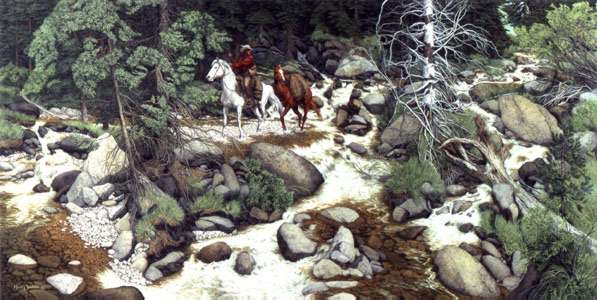
By the time the play opens, we’ll have run the play close to 20 times. There are lines of dialogue that didn’t make sense when we first went through the play. I read the line and wondered why it was in there. It didn’t make sense. But the more I performed the lines, and the more I got into the head of my character, the more the lines make sense. I came to the very pleasant and surprising conclusion that the author of this play very likely pored over every single line of the play. It feels almost like one of those Bev Doolittle paintings. At first glance you see one thing, but as you study it, you realize there is more there than first met the eye.

As a writer, this goes back to the whole show not tell idea. It’s easy to say, “Jim was furious.” It’s much harder to have Jim say something so that the reader understands that fury. But when it’s done well, it’s much more powerful.

That’s not to say you have to convey everything in dialogue. Sometimes a simple action can be just as powerful. Several folks in my writers group do this so well. They set the tone or emotion of a scene without ever having to say, “he felt”, or “he thought”. It’s harder to write this way. I can stack up the word count with the best of them, but I find when I try to focus on showing and not telling—when I’m really focused on dialogue not just to move the story along, but to give insight to character and emotion, it’s much more difficult. I find myself writing for an hour, with only a 300 word difference.

Words can do so much more than just express a fact, you just have to find the right ones.

Wednesday, September 21, 2011

The Book Academy

I've been invited to present at the UVU Book Academy. I attended this conference last year, and was very impressed. It's always fun to hang out with other writers, and UVU puts on a good conference. It's a full day, and at $49 you can't beat the price. Register today, since it's the last day to get the early bird discount.

Hope to see you there!